
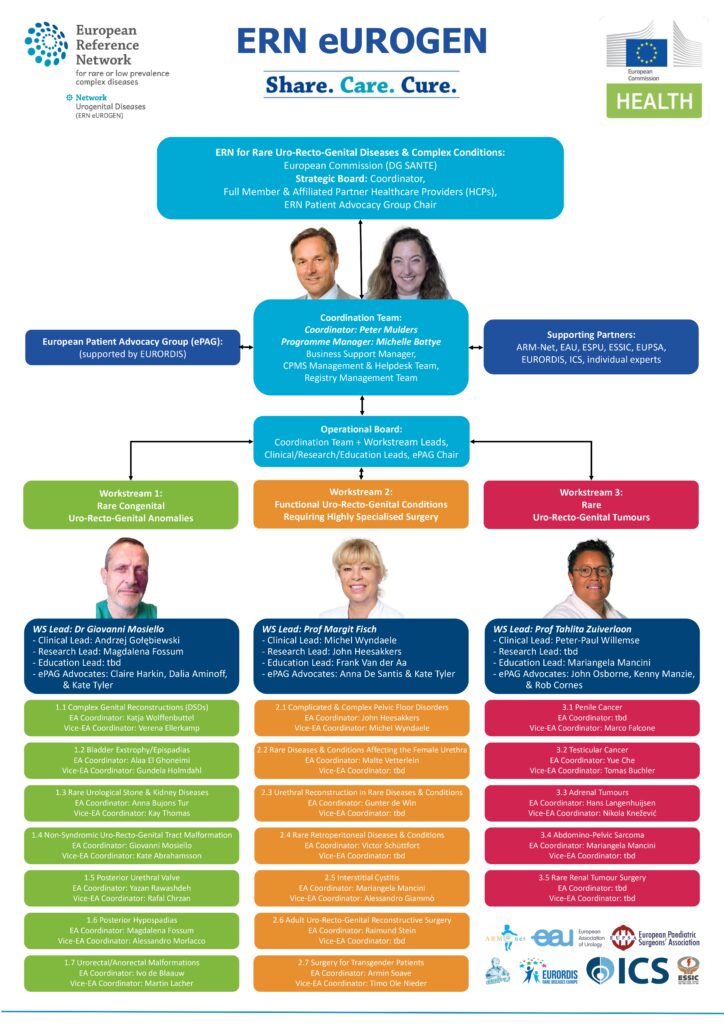
ERN eUROGEN operates as a non-profit network without its own separate legal entity, with a clear governance and coordination structure, in accordance with Article 12 of the EU Directive on Patients’ Rights in Cross-border Healthcare (2011/24/EU). Its governance sits within a wider EU structure and includes internal layers specific to the network. Two EU-level bodies oversee all 24 ERNs. The Board of Member States (BoMS), established in February 2014 and made up of nominated representatives from every EU Member State and Norway, is the central decision-making body: it approves new ERNs and new members, and can decide on the termination of an ERN or the loss of membership of an individual centre. The ERN Coordinators’ Group (ERN CG), comprising each network’s Coordinator, works alongside the BoMS on the operational and strategic aspects of the networks’ implementation, functioning, and governance, and ensures the consistency and efficiency of the ERNs’ actions, particularly regarding issues common to all ERNs. When required, the ERN CG may also advise the EC and the Member States on matters related to the ERNs. The Governance Statutes provide the foundational structure for how ERN eUROGEN operates and is managed. They set out common rules and obligations and ensure transparency, accountability, and the involvement of all stakeholders in the network’s decision-making. As set out in the network’s legal basis, every stakeholder is bound by the Governance Statutes decided by the Strategic Board. The sections below set out how ERN eUROGEN’s governance bodies fit together. For a single visual reference, please download the network’s Organisational Structure poster. Download the ERN eUROGEN Organisational Structure poster (PDF) An ERN Coordinating Healthcare Provider (Coordinating HCP) is the institution legally and financially responsible for the network: managing EC grants and their activities, and arranging the Coordination Team’s employment contracts. An ERN Coordinator is the individual who leads it, appointed by the Coordinating HCP’s Chief Executive Officer on the strength of their proven ability to coordinate and lead a network and their medically relevant activities in the field. Both roles are elected for five-year terms, renewable with Strategic Board approval. For its first two years, ERN eUROGEN’s Coordinating HCP was Sheffield Teaching Hospitals NHS Foundation Trust in the UK, under Coordinator Prof. Christopher Chapple. Following the UK’s withdrawal from the EU, Radboudumc in the Netherlands became the Coordinating Healthcare Provider from April 2019, with Prof. Wout Feitz as Coordinator. Prof. Feitz retired in May 2024, and Prof. Peter Mulders, also of Radboudumc, was appointed as the new Coordinator, following a formal transition protocol agreed with the network. Radboudumc is the sole beneficiary of EC funds provided to support the network, and brings established resources to that role: experienced legal, ethics, and privacy teams, an EU grants team, financial support, a clinical trials office, and data stewardship and protection support. Employees across multiple Radboudumc departments, both clinical and non-clinical, support the Coordinator and the wider Coordination Team, which helps keep the network’s management streamlined. The Coordinator chairs Strategic Board meetings, holding the deciding vote in the event of a tie, and represents ERN eUROGEN at European Commission and external meetings. Supported by the rest of the Coordination Team, the Coordinator oversees the network’s work, including: A Sub-Coordinator is appointed on the same basis, to deputise for the Coordinator. The Coordinator also sits on the ERN Coordinators Group, which brings together the Coordinators of all 24 ERNs to work on issues common to their implementation, functioning, and governance, and can advise the European Commission and Member States on matters relating to the ERNs. The Coordination Team is comprised of individuals with expertise in project management, business support management, data performance analysis, IT support, clinical knowledge of the EAs covered by ERN eUROGEN, and registry management. They support all aspects of network coordination relating to the work packages. The team meets weekly to ensure work stays on track. ERN eUROGEN Coordinator Pro Prof. Mulders is an expert in general and oncological urology. He conducts research both in the laboratory and clinical settings, focusing in particular on prostate and kidney cancer. His primary activities include urological patient care, teaching, and research in a multidisciplinary setting. ERN eUROGEN Programme Manager Therefore, Michelle oversees ERN eUROGEN’s work packages, and is responsible for drafting multiple European Commission (EC) grant proposals to secure ERN funding, managing and reporting on the grants, and fostering relationships with the EC. She also helps out with the EC ERN Monitoring Working Group (which ERN eUROGEN leads for all ERNs). Michelle has a background in European project management, European policy coordination, European partnerships, conference management, and training, and has worked for the European Commission, UK Government, and UK National Health Service (NHS). ERN eUROGEN Business Support Manager She assists the rest of the Coordination Team and all network members and partners, oversees emails to/from the network, arranges and facilitates virtual and face-to-face meetings, creates agendas and takes minutes, implements and maintains administrative and archival systems (e.g., the ERN Collaborative Platform), and assists with coordination and governance activities, including project management, grant writing, and report writing. With a background in both journalism and publishing, she is the production lead for the ERN eUROGEN book on rare and complex urology and is responsible for ERN eUROGEN’s dissemination activities, including maintaining the website, compiling the e-newsletters, managing social media, and anything else to do with the promotion of the network. ERN eUROGEN Clinical Specialist Parmida studied medicine in Nijmegen and obtained her medical degree in 2023. She will work on her PhD thesis on bladder exstrophy at the Pediatric Urology Department of Radboudumc. ERN eUROGEN Registry Coordinator Loes van der Zanden – Loes is developing ERN eUROGEN’s patient registry, facilitating its set-up, launch and maintenance. Loes gained her PhD in 2012, which involved paediatric urology data collection relating to genetics, environmental factors, and gene-environment interactions in the aetiology of hypospadias within the AGORA biobank. Since then, she has been carrying out postdoctoral research on genetic and environmental risk factors for congenital anomalies (AGORA) and coordinating an international EU FP7 Health Project, EuroTARGET (European collaborative project on TArgeted therapy in Renal cell cancer: GEnetic and Tumour-related biomarkers for response and toxicity). ERN eUROGEN Registry Manager In 2021, Lotte obtained her Master’s degree in Medical Biology at Radboudumc, Nijmegen. ERN eUROGEN has two governing bodies that sit above the Coordination Team’s day-to-day work: the Strategic Board, which holds formal decision-making authority over the network, and the Operational Board, which advises on strategy and activity where a full Strategic Board decision isn’t required. The European Patient Advocacy Group (ePAG) Chair sits on both, keeping the patient voice present at both levels. Strategic Board: In accordance with EC Delegated Decision 2014/286/EU, the Strategic Board is ERN eUROGEN’s main governing body. It comprises ERN eUROGEN Full Members, Affiliated Partners, and the ePAG Chair, and is chaired by the Coordinator. The Strategic Board must approve major decisions on the network’s leadership and membership: It also holds wider responsibility for: Operational Board: The Operational Board comprises the Workstream, Clinical, Education, and Research Leads, as well as the ePAG Chair. It advises the Coordination Team on objectives, strategy, and activities in cases where input from the full Strategic Board isn’t required, keeping routine strategic decisions moving without needing to convene the whole Board. ERN eUROGEN’s core membership is made up of Full Members and Affiliated Partners, both categories of healthcare provider (HCP) with a formal place in the network’s governance: As of December 2025, ERN eUROGEN comprised 56 healthcare providers across 20 EU countries: 51 Full Members in 15 Member States, 1 Associated National Centre, and 4 National Coordination Hubs. Patient representatives are embedded in the network’s governance and day-to-day work through the European Patient Advocacy Group (ePAG), not held at arm’s length from it. ePAG representatives review clinical practice guidelines, co-design care pathways and patient information, and contribute to training and dissemination activities alongside the Coordination Team and clinical experts. Supporting Partners are professional societies and individual experts who contribute expertise to the network without formal ERN membership. ERN eUROGEN’s current Supporting Partners are: ARM-Net, the European Association of Urology (EAU), the European Society for Paediatric Urology (ESPU), ESSIC, the European Paediatric Surgeons’ Association (EUPSA), EURORDIS, the International Continence Society (ICS), and individual experts. ERN eUROGEN’s clinical work is organised into three Workstreams, each divided into Expertise Areas* covering the specific rare diseases and complex conditions within its scope. Each Workstream has a Workstream Lead, Clinical Lead, Education Lead, and Research Lead (the same roles that sit on the Operational Board), and each Expertise Area has its own Expertise Area Coordinator (EAC) and Vice-EAC The WS Leads/EACs are responsible for organising the day-to-day working mechanisms of their respective groups. All subgroups are actively involved in implementing the Work Packages. The WS Leads and EACs ensure the flow of data and information within their specific group(s) and the provision of services and advice offered by ERN eUROGEN. *Note: Two Expertise Areas, differences in sex development (EA 1.1) and transgender patient surgery (EA 2.7), relate to individual identity rather than disease or disorder. For this reason, the network refers to Expertise Areas rather than “disease areas” throughout, in line with the EU’s principles of equality, diversity, and inclusiveness. Under ERN eUROGEN’s current EU4Health Direct Operational Grant (2023–2027), the network organises its work into nine work packages, each tied to a specific objective agreed with the European Commission. WP1 — Coordination. Strengthening the network’s organisational foundations: governance documents, risk assessment, the HCP performance indicator system, and annual network surveys. This work package also carried the network through the 2024 Coordinator transition, managed through a formal handover protocol. Our Development Strategy, as agreed by the Strategic Board, can be downloaded here. WP2 — Dissemination. Raising awareness of ERN eUROGEN’s work among clinicians, patients, policymakers, and professional societies. This includes ‘latest news’ items, e-newsletters, upcoming events, external media, social media, peer-reviewed publications, and participation in international conferences. You can download our dissemination plan and our dissemination report. WP3 — Evaluation. Monitoring the network’s performance in line with European Commission requirements, including an Evaluation Plan and annual indicators reporting. ERN eUROGEN also co-leads the cross-ERN Monitoring Working Group, contributing to how performance indicators are defined across all 24 networks. WP4 — Healthcare and CPMS. Supporting cross-border clinical collaboration through the Clinical Patient Management System (CPMS), which allows virtual expert consultations on individual patient cases. The network maintains a dedicated CPMS helpdesk and has supported 41 patient case discussions so far in the current grant period, through the transition to CPMS 2.0. WP5 — Registries, data management and analysis. Growing and using the ERN eUROGEN patient registry, designed to track long-term outcomes over 15 to 20 years. WP6 — Training and education. Delivering the network’s education programme: webinars, highly specialised surgical training courses, and reference books published with Elsevier. WP7 — Clinical Practice Guidelines and Clinical Decision Support Tools. Developing evidence-based guidance to harmonise care across Europe. WP8 — Capacity building and best-practice sharing for Ukraine. A dedicated webinar programme and collaboration with Ukrainian healthcare authorities, including the Rare Diseases Hub in Kyiv and OMNI-Net. WP9 — Other activities for Ukrainian competent authorities and healthcare units. Complementing WP8 with direct support: CPMS access for Ukrainian clinicians and dissemination of ERN eUROGEN’s clinical guidelines and patient materials to Ukrainian partners.Governance & Coordination
EU-Level Oversight
Governance Statutes
Organisational Structure
Coordinating Healthcare Provider and Coordinator
Coordination Team
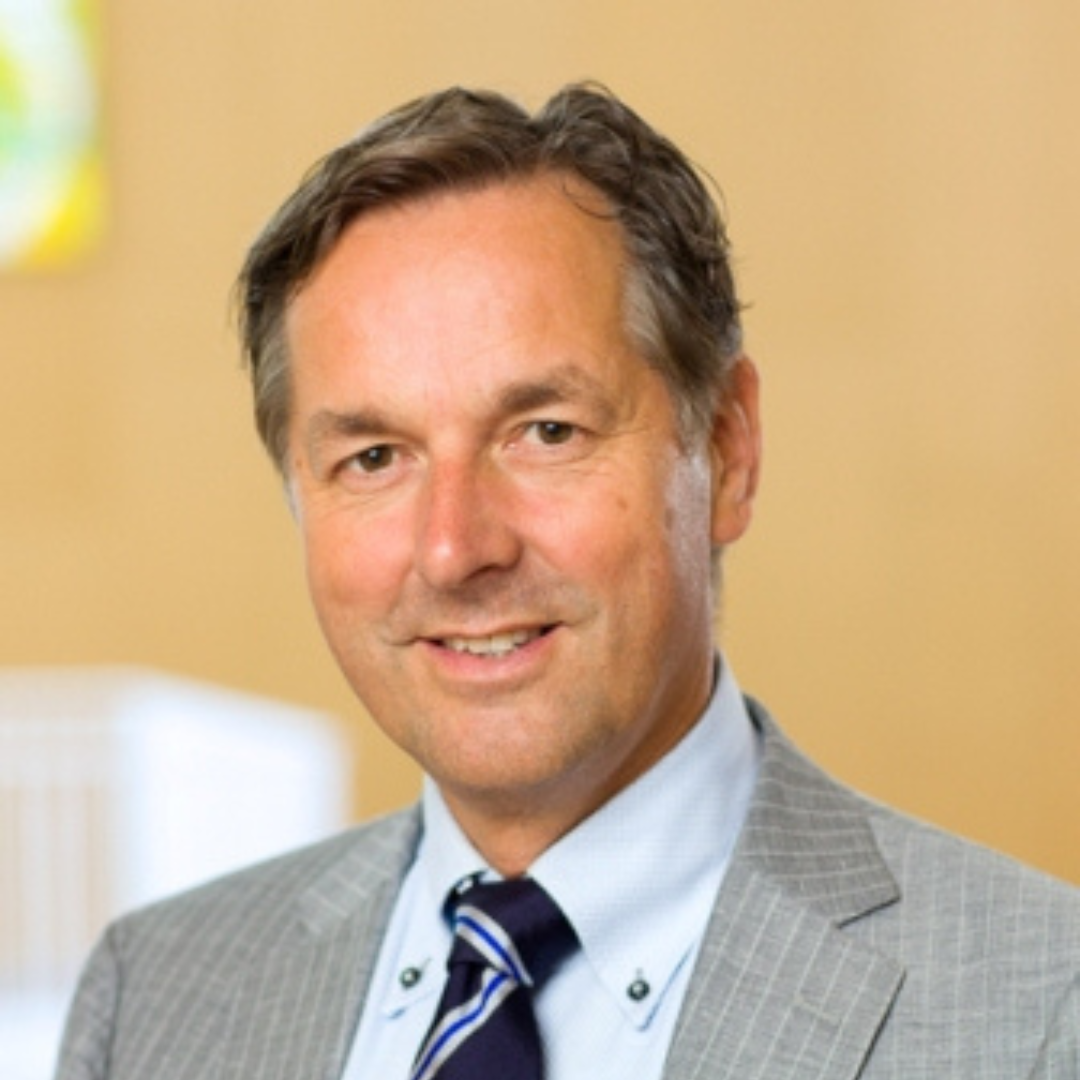 f. Peter F.A. Mulders – has overall responsibility for the ERN eUROGEN work packages, submitting European Commission (EC) grant proposals to secure ERN funding, managing and reporting on the grants, and fostering relationships with the EC.
 Michelle Battye – Michelle is responsible for all operational aspects of the network, reporting to the HCP Network Coordinator Representative, Prof. Wout Feitz. Her main focus is on ensuring the network is active, working together as a team, and that it is delivering.
  Jen Tidman – Jen is responsible for supporting and managing the administrative aspects of ERN eUROGEN’s business and day-to-day coordination.
 Parmida Anvary – Parmida facilitates the virtual multi-disciplinary team meetings that ERN eUROGEN holds using the Clinical Patient Management System (CPMS) and coordinates the ERN eUROGEN webinar programme.
 Lotte Boormans – Lotte is the Registry Manager of the ERN eUROGEN. In that role, she helps Loes set up and maintain the patient registry. She is also a contact person for the HCPs, to assist with implementing the registries and answering any practical questions.
Strategic Board and Operational Board
Full Members & Affiliated Partners
European Patient Advocacy Group (ePAG)
Supporting Partners
Workstreams and Expertise Areas
Work Packages
Work Packages
Governance & Coordination