
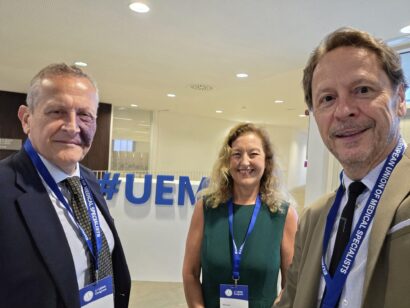
Giovanni Mosiello, Michelle Battye, and Christian Radmayr at the 1st UEMS Congress, 2026
On Saturday, 30 May 2026, the first Congress of the European Union of Medical Specialists (UEMS) took place in Leuven, Belgium. ERN eUROGEN presented a session titled “Future of healthcare systems and the role of the European Reference Networks (ERNs) – innovation in collaboration (ERN eUROGEN experience)” with the aim of reaching clinicians across different medical fields who may not be aware of the ERNs and what they do.
The Congress opened with an address by Oliver Várhelyi, European Commissioner for Health and Animal Welfare, who spoke on the future of medical education and practice. He underlined that Europe needs a strong, skilled, and resilient health workforce that is ready to embrace innovation, digital tools, and new care models, while keeping patients at the centre.
In the ERN eUROGEN session, Michelle Battye, Programme Manager, gave an overview of the ERN system and explained how ERNs can transfer knowledge to clinicians and help patients with rare diseases and complex conditions.
Giovanni Mosiello, Workstream 1 Lead (rare congenital uro-recto-genital anomalies), described the benefits of cross-ERN collaboration at the EU level, illustrating the tangible results of collaboration between three ERNs: ERN eUROGEN (rare uro-recto-genital diseases and complex conditions), ERN ITHACA (congenital malformations and rare intellectual disabilities), and ERKNet (rare kidney diseases).
Finally, Christian Radmayr described how the European Association of Urology (EAU), European Society for Paediatric Urology (ESPU), ERN eUROGEN, ERN ITHACA, ERKNet, and the International Federation for Spina Bifida and Hydrocephalus (IFSBH) formed a working group, which he kindly led, to standardise the approach to care for paediatric patients with spinal dysraphism through the development of a Clinical Practice Guideline for Spinal Dysraphism in Children and Adolescents.
The session demonstrated ERN eUROGEN’s commitment to reaching beyond its existing membership and sharing the ERN model with the broader European medical specialist community. By engaging an audience of leaders from across medical disciplines, ERN eUROGEN reinforced that rare disease expertise and cross-border collaboration are not niche concerns but central to the future of European healthcare. We look forward to building on the connections made in Leuven and to continuing to make the case for rare disease patients at forums where their voices might not otherwise be heard.
Related Articles
-
eUROGEN Webinar: Intermittent (self-)Catheterisation in children: Teaching, guidance and follow-up care by nurse specialists & urotherapists
-
ERN eUROGEN Webinar: Challenges in oncologic treatment of retroperitoneal sarcomas
-
eUROGEN Webinar: Female Incontinence – from diagnosis to treatment in complex cases
-
EJP RD: Training on Undiagnosed Rare Disease Cases