
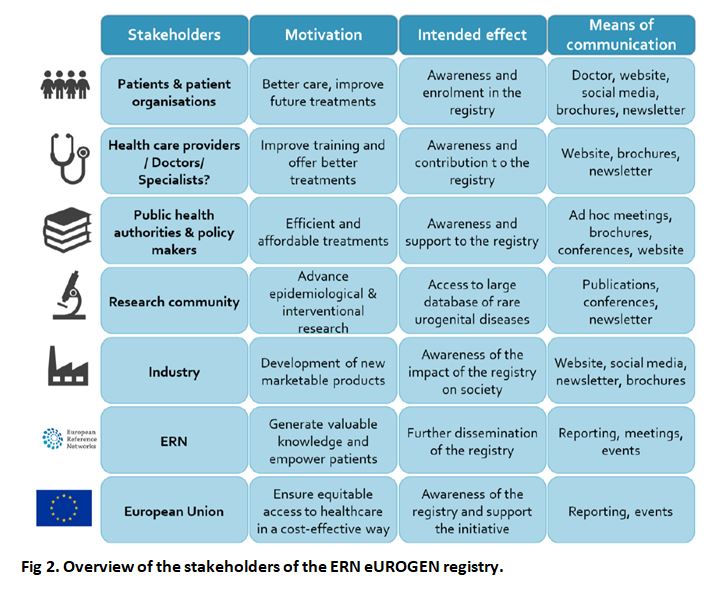
The ERN eUROGEN patient registry collects data from patients with rare uro-recto-genital diseases and complex conditions, designed to follow outcomes over the long term, 15 to 20 years, rather than a single episode of care. This strengthens the evidence base for these conditions, allows comparison of care across centres, and supports research and innovation. The registry is growing steadily with healthcare providers gaining full legal and ethical approval to participate. This includes centres from the ARM-Net Consortium’s own anorectal malformation registry, which was folded into the ERN eUROGEN registry to avoid duplicate data collection and ensure GDPR compliance. Data collected include Clinical Practice Snapshots, taken a year after a patient’s first visit; follow-up eCRFs for longer-term outcomes; and patient-reported outcome measures (PROMs). In line with FAIR principles (findable, accessible, interoperable, and reusable), the registry is also piloting a pseudonymisation tool to support secure, GDPR-compliant data sharing. Researchers, clinicians, patient organisations, policymakers, and companies can all apply to use registry data for approved purposes. This video explains the concept of the ERN eUROGEN registry for patients: Until now, very limited data have been gathered on disease progression, surgical procedures, and treatment outcomes, and the few existing databases are not standardised, fragmenting and scattering the information. Moreover, long-term follow-up of treatment outcomes into adolescence and adulthood is lacking, hindering improvement over time. The ERN eUROGEN registry has several objectives: The final ERN eUROGEN registry will benefit patients and their families who go through a diagnosis odyssey, physicians who will learn about rare and complex conditions and get new insights into the best treatment options, and scientists who are looking for patient cohorts for future research and clinical trials. The Principal Investigators at Healthcare Providers (HCPs) involved in ERN eUROGEN as Full Members or Affiliated Partners will ensure that the implementation of the ERN eUROGEN registry complies with their HCPs’ rules and regulations. This may mean they need to apply for local approval for implementation of the ERN eUROGEN registry. Participation in the ERN eUROGEN registry is also open to non-member/partner HCPs. After obtaining ethical and legal approval, HCPs will begin prospectively including all new patients attending their centre for any ERN eUROGEN Expertise Area in which they are involved. HCPs will also include patients who attended the HCP for an ERN eUROGEN Expertise Area for the first time between 2022 and now. A protocol is available to guide the retrospective patient inclusion process. Only patients who provided (or whose parents/legal representatives provided) informed consent will be included in the ERN eUROGEN registry. The ERN eUROGEN platform will be built on the collection of core data set elements and domain-specific elements for specific rare uro-recto-genital diseases. Thus, the registry will comprise the following sets of data: 1. The JRC common data set (CDE), defined by the EU RD Platform, has 16 data elements describing patients’ general health status. The CDE is common to all rare disease registries, serves as the connecting point for all ERN databases, and ensures that individuals are uniquely identified and not duplicated across different rare disease registries: 2. Uro-recto-genital “Clinical Practice Snapshots” initially consist of six clinical questions (around 10 data elements) per Expertise Area that describe the care pathway of patients in the first year after the start of treatment for the rare uro-recto-genital disease or complex condition. These data enable us to perform a snapshot of the current clinical practices in the EU. Clinical Practice Snapshots have been developed for the following Expertise Areas: ➡️ Bladder Exstrophy (EA 1.2) (version 21 August 2024) We are currently working on the Clinical Practice Snapshots for the other Expertise Areas. 3. In addition, the dataset will be expanded with clinical follow-up forms that will collect information on further treatments and outcomes. These are currently under development. 4. We will also send out Patient Reported Outcome Measures (PROM) questionnaires. There will be questionnaires about satisfaction with the care process (H-care survey) and about health-related quality of life (PedsQl questionnaire for patients from Workstream 1 and SF-36 or RAND-36 for patients from Workstream 2 and Workstream 3). A short guide has been produced for the PROM questionnaires in the ERN eUROGEN registry, along with their current status as of September 2024: Schematic overview of data collection in the ERN eUROGEN registry. Note that the shaded blue colours indicate who will fill out the information, and that parts of the Informed Consent forms and PROM questionnaires are filled out by either patients or their parents, depending on the patient’s age. The data in the ERN eUROGEN Registry will be made Findable, Accessible, Interoperable, and Reusable for humans and computers (i.e., FAIR). ➡️ ERN eUROGEN Registry – FAQ EA 1.5 Posterior Urethral Valves (version 1 May 2024) The ERN eUROGEN registry will be implemented in Castor using a Data Processing Agreement between Radboudumc and Castor. Only Healthcare Providers who have signed the Data Sharing Agreement will obtain access to the online registry. Access for authorised users to the online registry is controlled by assigning a secure, individualised password. Scientific Researchers, clinicians, patient organisations, policymakers, companies, etc., are invited to apply to use data from the ERN eUROGEN registry. The Data Access and Sharing Policy describes the data request process. Parmida Anvary, Radboudumc, Nijmegen, The Netherlands: Overview of surgical care for primary closure of Classic Bladder Exstrophy (2025-2027) Parmida Anvary, a PhD student from Radboudumc in Nijmegen, the Netherlands, will conduct a study on classical bladder exstrophy. She will use the data from the ERN eUROGEN registry to create an overview of how the different centres participating in the ERN eUROGEN registry deliver surgical care for primary closure. This will allow her to clearly describe what primary closure entails at each individual centre. She will also create an overview of the different countries in general. She will not only look at the type of primary closure but also focus on the pre-operation care, wound coverage if the closure is delayed, location of the closure surgery (to get an overview of the centralization of CBE care), types of immobilization post-operatively and the effect on bladder dehiscence, wound drainage after the primary closure, and reoperations for complications. Ideally, she wants to be able to conclude which operations have the best outcomes and implement those into a future guideline. Yazan Rawasdeh, Aarhus University Hospital, Aarhus, Denmark: Improving Care for Children with Posterior Urethral Valves (2025) In collaboration with experts from ERN eUROGEN, Associate Professor Yazan Rawashdeh from Aarhus University, Denmark, recently co-authored a Clinical Consensus Statement on the management of Posterior Urethral Valves (PUV). The next step for the expert team is to compare these consensus recommendations with current clinical practice across Europe. Using data from the ERN eUROGEN registry, the team will analyse the epidemiology, geographical distribution, procedure numbers, and management details of PUV cases. This work aims to identify areas where patient management can be improved and harmonized, ultimately enhancing outcomes for this rare patient group and guiding future research and collaboration efforts. Reports comparing clinical practice among different Healthcare Providers have been generated: 2026: 2025: 2024: 2023: The PhD thesis of Loes Oomen, former ERN eUROGEN Clinical Data Specialist, shows some research options related to long-term registries. The stakeholders of the ERN eUROGEN Registry are the groups in society who will be positively affected by ERN eUROGEN’s Registry outcome. These are: In managing the ERN eUROGEN registry, different people have different roles as described in the protocol: Radboudumc is the coordinator of the ERN eUROGEN registry. It has contracted with Castor EDC, a tradename of company Ciwit B.V. to allow the centralized storage of the Study Data. Given the fact that the Provider (the hospital participating in the ERN eUROGEN registry) and Radboudumc jointly developed and determined the purposes and means of the ERN eUROGEN registry, Parties shall be joint Controllers. However, Radboudumc, as the central Party that coordinates the ERN eUROGEN registry, shall be responsible for the storage and the use of the transferred data. Radboudumc shall ensure that appropriate technical and operational measures are in place to safeguard against any unauthorized or unlawful processing of the Study Data and against accidental loss or destruction. Radboudumc shall promptly, and in any event within 48 hours, notify the Provider about any actual or suspected breach of the Data Protection Legislation in relation to any Study Data. The Provider is responsible to obtain and maintain any required ethical approval or similar necessary for the provision of Study Data to the ERN eUROGEN registry. In addition, the Provider is responsible for obtaining any required informed consent from each Data Subject before enrolling the respective Data Subject into the ERN eUROGEN registry and before transferring any data from that Data Subject. To that regard the Provider shall use the patient information and consent form as approved by its competent ethics committee. The consent shall cover inter alia the transfer of pseudonymized data (i.e. removing all sensitive personal data, including but not limited to patient names, initials, and other personally-identifiable information, and leaving only a coded Data Subject number) to Radboudumc and for use within the ERN eUROGEN registry and in scientific research projects approved in accordance with the Data Access and Sharing Policy; Notwithstanding the division of responsibilities set out above, the Parties shall be jointly responsible for the compliance to obligations imposed by the Data Protection Legislation (Article 26 of the GDPR), and the Parties shall cooperate to do all necessary things to enable performance of such compliance obligations. Given the fact that Radboudumc will not have the key to the coded Study Data provided by Provider, The Parties agree that the Provider is primarily responsible for managing Data Subject requests exercising their rights under the GDPR and will comply with article 12 of the GDPR in order to respond to such a request. However, the Parties acknowledge that Data Subjects are allowed to exercise their rights under the GDPR against both Parties. If a Data Subject makes a request to Radboudumc, Radboudumc will notify the Provider about the request without undue delay. Radboudumc will assist Provider in complying with its obligation to provide an answer to Data Subject requests.Patient Registry
Patient Information Video
Aim
Implementation & Informed Consent
➡️ ERN eUROGEN Registry Retrospective Protocol (version 15 April 2026)
➡️ ERN eUROGEN Registry Patient Informed Consent FormDatasets
➡️ ERN eUROGEN Registry Common Data Elements (version 10 March 2022)
➡️ Posterior Urethral Valves (EA 1.5) (version 30 April 2024)
➡️ Anorectal Malformations (EA 1.7) (version 15 January 2025)
➡️ Paediatric Kidney Transplantations (EA 1.8) (version 22 August 2022)
➡️ Complicated Pelvic Floor Disorders (EA 2.1) (version 9 November 2022)
➡️ Testicular Cancer (EA 3.2) (version 4 October 2023)
➡️ Adrenal Tumours (EA 3.3) (version 3 September 2024)
➡️ ERN eUROGEN Registry Patient Reported Outcome Measure (PROM) Questionnaires Factsheet (version 24 February 2025)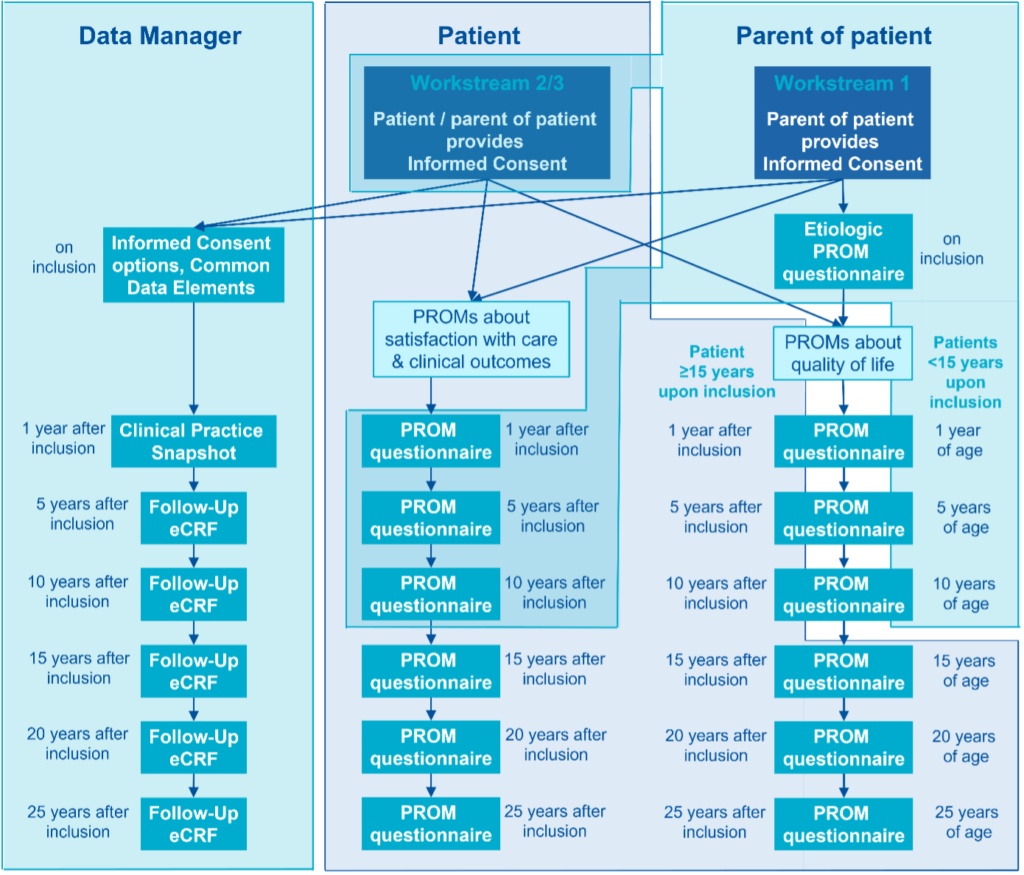
Frequently Asked Questions (FAQs)
➡️ ERN eUROGEN Registry – FAQ EA 1.7 Anorectal Malformations (version 11 September 2025)
➡️ ERN eUROGEN Registry – FAQ EA 2.1 AMS800 (version 25 April 2024)
➡️ ERN eUROGEN Registry – FAQ EA 3.3 Adrenal Tumours (version 6 October 2023)
➡️ ERN eUROGEN Registry – FAQ Common Data Elements (version 24 February 2025)Data Access
➡️ ERN eUROGEN Registry Data Sharing Agreement
➡️ ERN eUROGEN Registry Data Access and Sharing Policy (version 24 February 2025)Projects Granted Access
Research Results
Reports
PhD Thesis
Stakeholders
Project Management
➡️ ERN eUROGEN Registry Protocol (version 3 July 2026)
➡️ ERN eUROGEN Registry Data Access and Sharing Policy (version 24 February 2025)GDPR Responsibilities
Patient Registry