 DeCODe (Develop Child and Orphan Device Evaluation support), an EU4Health project in which ERN eUROGEN was a consortium partner, ended on 30 August 2026. For two years, the project worked to improve the development of medical devices for children with rare diseases.
Why the project was needed
Too few medical devices are designed specifically for children with rare diseases. Paediatric and orphan devices can serve essential functions for patients, their carers and the healthcare professionals who use them, but many patients still manage with devices that were never made for their condition. Small patient populations make these devices commercially unattractive, and developers often struggle to navigate regulation, funding and clinical evaluation.
DeCODe brought together clinicians, researchers, industry experts and regulatory authorities to address this gap. Alongside ERN eUROGEN, the consortium included MetabERN, making the project an example of two ERNs pooling their expertise on a shared problem.
What DeCODe did
The project first mapped existing paediatric and orphan medical devices, along with the stakeholders, tools, incentives, and initiatives in the field. This landscape work fed into a critical pathway analysis to identify the best route for developing new paediatric and orphan medical technologies.
DeCODe then opened a call for support to developers across Europe, including patient-led groups, academic teams and small and medium-sized enterprises. Selected developers received expert guidance as they moved their devices towards prototypes, business plans, clinical data collection and certification.
Lessons from the project
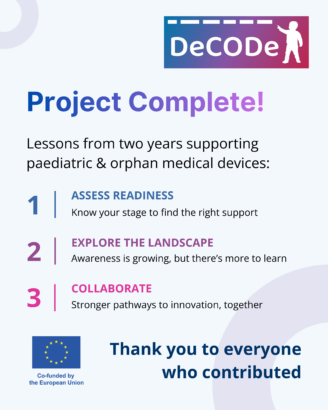
The final publications are still in preparation, but the consortium has already shared three lessons from its work.
- Developers should regularly assess the maturity and readiness of their device. Knowing where a project stands in its development makes it easier to find the right support at the right time.
- The landscape keeps changing and is worth revisiting. Awareness of orphan devices is growing, yet many developers still don’t know about the tools, incentives, and opportunities available to them.
- Progress depends on collaboration. When clinicians, patients, regulators, technical experts and business developers work together, the path from idea to device becomes clearer and more robust.
The wider policy context
DeCODe ran at a time of growing EU attention to orphan devices. EU guidance published in June 2024 set criteria, for the first time, for medical devices intended for small patient populations to qualify as orphan devices (read the guidance here), and such devices may benefit from free advice from expert panels. Following a pilot phase that began in 2024, the European Medicines Agency now offers an established process for manufacturers and notified bodies to request expert panel advice on orphan devices (read more here).
What happens next
The consortium will publish its final papers in the coming months. ERN eUROGEN will share them as they become available.
In the meantime, you can find the project’s tools, stakeholder overview and deliverables on the DeCODe website: https://decode-rd.com/
We thank our fellow consortium partners, the developers who took part, and everyone who contributed to DeCODe over the past two years.
DeCODe was funded by the European Union under grant agreement no. 101160939.