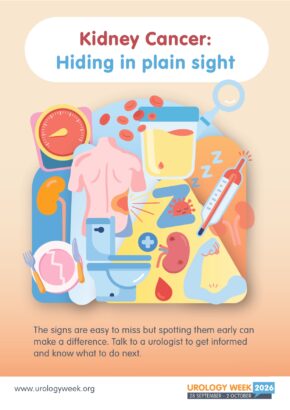
 This year’s Urology Week, running from 28 September to 2 October 2026, puts kidney cancer in the spotlight. As the European Association of Urology’s campaign highlights, kidney cancer often causes few or no symptoms in its early stages, meaning many people are not prompted to seek medical attention until later.
ERN eUROGEN is using the occasion to draw attention to a group of rare conditions that sit within this picture but remain especially underdiagnosed: hereditary forms of renal cell carcinoma (RCC), the most common type of kidney cancer.
Underdiagnosed and easy to miss
Hereditary RCC is caused by inherited genetic conditions, including von Hippel-Lindau disease (VHL) and hereditary leiomyomatosis and renal cell cancer (HLRCC). Because these conditions are rare, and because kidney cancer itself is often silent in its early stages, cases can be missed even by specialist teams.
Recent work led by Prof. Roman-Ulrich Mueller’s group in Düsseldorf has helped quantify this gap. A newly established screening tool, now part of the German RCC certification criteria and referenced in the German S3 guideline for structured risk evaluation, has shown that the prevalence of hereditary forms may be considerably higher than expected, particularly in expert centres. The full analysis is available in Clinical Kidney Journal.
A consensus on treating von Hippel-Lindau-associated kidney cancer
For patients with VHL, a genetic cause behind their kidney cancer increasingly means a genetically informed treatment option. Belzutifan, a targeted therapy, is now available for VHL-associated RCC, and using it correctly requires close collaboration across specialities and borders.
Five European Reference Networks, ERN eUROGEN, ERKNet, ERN-EYE, Endo ERN and ERN GENTURIS, are working together on a consensus statement to guide the use of Belzutifan in VHL.
The International Kidney Cancer Coalition (IKCC), VHL Europa, and the ERA Genes & Kidney Working Group also support the initiative.
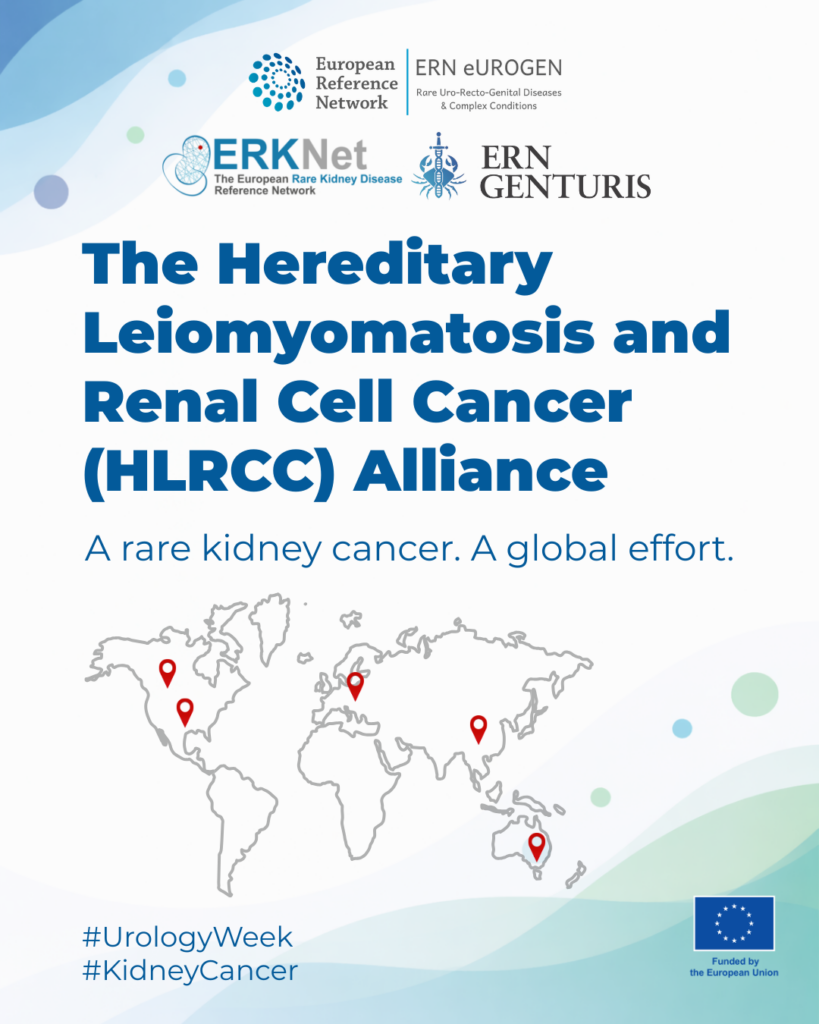
The HLRCC Alliance
A second rare hereditary kidney cancer, HLRCC, is the focus of a newly founded international alliance bringing together patient representatives, clinicians and scientists from Europe, the USA, Canada, Asia and Australia, with a shared biobank at its core. ERN eUROGEN is one of several networks and organisations supporting the Alliance, alongside ERKNet, ERN GENTURIS, IKCC, the ERA Genes & Kidney Working Group, the HLRCC Foundation, and the Uropathology Working Group of the European Society of Pathology.
Its first published output, a statement responding to the new WHO pathology classification for renal cell carcinoma, is now available.
Looking ahead: modelling hereditary kidney cancer
Looking further ahead, a consortium coordinated in Düsseldorf has recently submitted a proposal to a Horizon Europe call to build “virtual twins” for patients with hereditary RCC, aiming to improve how these cancers are identified, assessed, monitored and treated. The proposal brings together clinical centres in Nijmegen, Stockholm, Birmingham, Aarhus, Freiburg and Düsseldorf with experts in digital modelling.
ERN eUROGEN is currently the only European Reference Network directly involved in the proposal itself, though the wider network of collaborators remains open to future involvement.
Get involved
Across all this work, the message is the same: hereditary kidney cancer is more common than it might appear, and recognising it early makes a real difference to patients.
Follow ERN eUROGEN’s social media channels throughout Urology Week for more and visit urologyweek.org for the official campaign resources