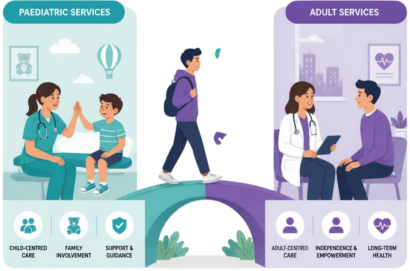
 ERN eUROGEN has published Transition Care for Individuals with Rare Uro-Recto-Genital Conditions: A Lifelong, Patient-Centered Approach, a new guidance document setting out how young people with rare uro-recto-genital conditions should be supported as they move from paediatric to adult healthcare.
The document was developed by the ERN eUROGEN Transition & Lifelong Care Working Group, chaired by Raimund Stein and bringing together clinicians and patient representatives with expertise or lived experience across the conditions covered by ERN eUROGEN’s paediatric workstream, Workstream 1: Rare Congenital Uro-Recto-Genital Anomalies. Combining clinical and patient perspectives in a single working group reflects how the network expects transition care itself to work: as a shared process between healthcare professionals, patients, and families, not a handover managed by clinicians alone.
Why transition care needs its own guidance
Advances in medical and surgical treatment mean more people with complex congenital conditions are now living into adulthood, and their healthcare needs continue to evolve well beyond childhood: urinary and bowel function, kidney health, sexual health, fertility, psychosocial wellbeing, education, employment, body image, and independent living can all be affected. Many will have had multiple interventions as children and need lifelong surveillance and support.
Despite this, transition care across Europe remains inconsistent. Where structured pathways are missing, patients risk fragmented care, loss to follow-up, preventable complications, and a lower quality of life. This publication sets out what good transition care looks like and why it should be treated as an ongoing process rather than a single event tied to a patient’s age.
What the document contains
The publication covers:
- the principles that should underpin transition care, including individualised transition plans, a named transition coordinator for every patient, and a comprehensive transition summary provided at the point of transfer
- the two models of care currently used in Europe: the transfer model, where patients move to a different adult service, and the integrated lifelong care model, where they remain within the same institution as care evolves from paediatric to adult provision
- system-level requirements for healthcare providers and health systems
- seven formal recommendations
- a condition-by-condition breakdown across all of Workstream 1’s expertise areas, from Differences of Sex Development and Bladder Exstrophy–Epispadias Complex through to Anorectal Malformations, each listing the core specialists who should definitely be involved, additional specialists who are recommended, and roles considered optional
The seven recommendations are
- All individuals with rare uro-recto-genital conditions should have access to a structured transition programme as part of lifelong follow-up.
- Transition should be recognised as a continuous process rather than a single transfer event.
- Transition planning should begin early and be reviewed regularly.
- Every patient should have a named transition coordinator and an individualised transition plan.
- Patients and families should be active partners in transition planning and decision-making.
- A comprehensive transition summary and future care plan should accompany every transfer to adult services.
- Healthcare providers unable to offer structured transition care should establish referral pathways to centres with dedicated transition programmes.
The document also highlights the role of patient advocacy groups in supporting transition through education, peer support, and continuity of care beyond clinical settings, and calls for stronger partnerships among healthcare professionals, patients, families, and advocacy organisations.
Who this is for
This publication is intended for:
- clinicians and multidisciplinary teams caring for children, adolescents, and adults with rare uro-recto-genital conditions
- healthcare providers and centres reviewing or setting up transition pathways
- patient advocacy groups supporting members through the transition process
- national health systems and policymakers working to improve continuity of specialist care
Read the document
➡️ The full publication is available from the ERN eUROGEN Guidelines page
Clinicians and centres are encouraged to review their current transition pathways against the recommendations, and patient organisations are welcome to share the document with members who may be approaching or going through transition.