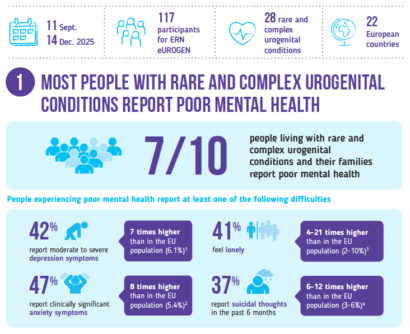
 Between September and December 2025, 117 people living with rare and complex uro-recto-genital conditions, from 22 European countries, took part in the EURORDIS Rare Barometer survey on mental health. The results, now available in a dedicated ERN eUROGEN factsheet and online dashboard, give us the clearest picture yet of how our community is coping, and where the gaps in support remain widest.
The survey covered 28 different rare and complex uro-recto-genital conditions. The findings echo, and in some areas exceed, the wider European results published by EURORDIS from almost 9,900 respondents across 45 countries.
The headline figures
Seven in ten people living with a rare or complex uro-recto-genital condition, and their families, report poor mental health.
Within our community specifically: 42% report moderate to severe depression symptoms, seven times the rate seen in the general EU population; 47% report clinically significant anxiety symptoms, eight times the EU rate; 41% feel lonely, up to 21 times the EU rate; and 37% report suicidal thoughts in the past six months, up to 12 times the EU rate.
These are not isolated difficulties. Half of respondents reported experiencing at least two of the four difficulties measured, and one in ten reported all four at once.
A gap between needing support and getting it
The most striking finding may be this: 89% of respondents said they had needed professional psychological support in the past six months. Only 61% received it. Where support was accessed, general practitioners and nurses were the most common source (32%), followed by charities and advocacy organisations (29%). Reimbursed and non-reimbursed mental health professionals, such as psychologists, psychotherapists or psychiatrists, were each cited by only 20% of respondents, and centres of expertise by 18%. Community support filled some of the gap: 74% of respondents said they had received emotional support from family, friends or neighbours, though this is rarely a substitute for professional care.
How this compares across Europe
The pattern in our community mirrors, and in places exceeds, what EURORDIS found across the broader rare disease population. Among the wider European sample, 44% reported moderate to severe depression symptoms, 42% clinically significant anxiety, 45% loneliness, and 31% suicidal thoughts in the past six months. Across Europe, 73% of respondents said they had needed professional psychological support, but only 49% received it.
EURORDIS notes that these levels of psychological distress are comparable to those recorded during the COVID-19 pandemic, and to those found in other highly vulnerable populations. For people living with a rare disease, however, this is not a temporary crisis. It is daily life.
Why this matters for ERN eUROGEN
These findings reinforce what many in our community have long said in other contexts: psychological support needs to be built into rare disease care, not treated as an optional extra.
EURORDIS is calling for the 30 million people living with a rare disease in Europe to be formally recognised as a vulnerable population within EU health policy, and for health professionals to receive more training in the realities of rare conditions.
We will be looking at how these results can inform our own guidelines and training work, and at how centres of expertise across the network can better connect patients with mental health professionals who understand the specific challenges of rare uro-recto-genital conditions.
Access the full results
👉 ERN eUROGEN factsheet
👉 ERN eUROGEN tailored dashboard with full results for our community
👉 European cross-disease/condition results, including factsheets in 25 languages (the full European survey report will be published here in October 2026)
👉 EURORDIS webinar on the European results
👉 Rare Barometer
If you are affected by anything in this article and need support, you can contact someone anonymously by phone or chat in your country via blog.opencounseling.com/suicide-hotlines or befrienders.org.This survey was conducted by Rare Barometer, a not-for-profit initiative run by EURORDIS-Rare Diseases Europe. ERN eUROGEN thanks all participants and Rare Barometer partners who made these results possible.