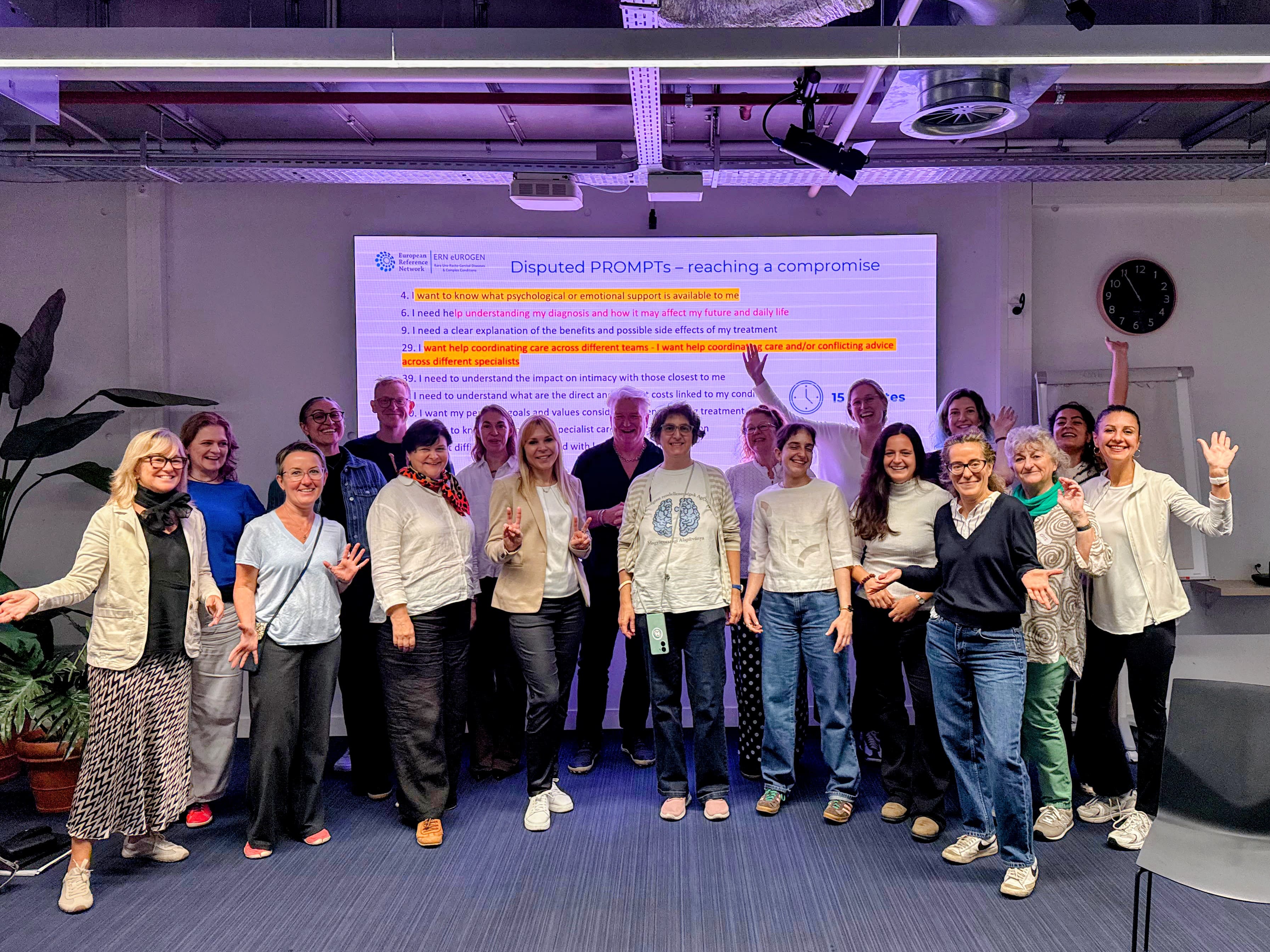
 Patient representatives and clinicians from nine European Reference Networks (ERNs) met at the Radboudumc Experience Center in Nijmegen on Wednesday 30 September and Thursday 1 October 2026. Together, they agreed on the core prompts for a new question prompt list (QPL) to help people living with rare and complex conditions prepare for appointments with specialists.
The workshop ran over two half-days and was a key milestone for Rare PREPARE. John Osborne, ERN eUROGEN ePAG Chair, initiated the project, and ERDERA (the European Rare Diseases Research Alliance) funded the workshop through its Networking Support Scheme.
Professor Peter Mulders, ERN eUROGEN Coordinator, opened the meeting. John Osborne led the workshop. Nora Lázaro and Inés Hernando of EURORDIS facilitated it with Jen Tidman and Parmida Anvary of the ERN eUROGEN Coordination Team.
How a question prompt list helps patients prepare for appointments
A question prompt list is a short list of topics that patients and caregivers can use to prepare for appointments. The Rare PREPARE QPL is for adults in their first year after diagnosis with a rare or complex condition, and for caregivers of people in their first year after diagnosis. It is designed to help them prepare for appointments with specialists.
Clinicians could send the list to patients before a consultation, or hand it out in the waiting room, so that both know which topics the patient wants to raise. Patients and caregivers can also use it on their own as a memory aid when they prepare for appointments. The planned format is a printable, accessible PDF of up to four pages, in plain English.
Patients and clinicians from 11 ERNs
Rare PREPARE is a great example of cross-ERN collaboration, bringing together patient representatives and clinicians from 11 ERNs. The 16 panel members at the workshop came from 11 countries and from ERN eUROGEN, ERN CRANIO, ERN EYE, ERN GuardHeart, ERN ITHACA, ERN LUNG, ERNICA, ERKNet and Endo-ERN. Seven were patient representatives, and nine were clinicians. Members of ERN ReCONNET and ERN NMD also took part in the panel’s rating and ranking exercises before the workshop.
In his welcome, Professor Mulders described Rare PREPARE as a collective effort, built by patient representatives and clinicians from different ERNs working side by side.
How the prompts were chosen
The starting point was a scoping review that identified 71 categories of patient experience across 11 domains. The Rare PREPARE core working group narrowed these to 10 categories in 5 domains. It then drafted 91 prompts, which went down to 85 after review. Panel members rated the prompts in April 2026 and then ranked a shortlist of 30, producing a Top 20 for discussion in Nijmegen.
At the workshop, patient representatives and clinicians first worked in separate groups, then in mixed groups, and finally together in plenary. Each stage combined silent individual voting, group discussion and five-finger consensus voting. Participants also checked that the list would work for surgical and non-surgical conditions, and for adult-onset and childhood-onset conditions.
Ten prompts to help patients prepare for appointments
All 14 participants present for the final vote supported the list of 10 prompts. Five strongly supported it, nine supported it, and no reservations or objections were recorded. Several prompts were reworded or combined during the discussions, and a prompt on costs was brought back from the reserve list. The agreed prompts cover:
- psychological and emotional support
- understanding the diagnosis and how it may affect future and daily life
- the benefits and possible side effects of treatment
- coordinating care across different teams
- the impact on intimacy with those closest to the patient
- the direct and indirect costs linked to the condition
- personal goals and values when choosing treatment
- access to specialist care for a rare condition
- staying motivated with long-term treatment
- how treatment decisions and changes are made when evidence is limited
Next steps and future aims
The core working group will review the outcomes by the end of 2026. It will settle the remaining wording questions and consider whether some prompts should be merged. It will also decide whether the QPL should include extra optional prompts alongside the core 10, for example on self-management and continuity of care. EURORDIS will review the language so that every prompt is accessible, and the group will agree on the final design and the instructions for patients and clinicians.
The workshop also looked beyond the QPL. In a “Let ideas flow” networking session, three champions turned priorities raised by participants into goals for the next one to two years:
- Anna Radová (ERN EYE) proposed basic information on Usher syndrome after diagnosis in all EU and EEA languages.
- Kate Tyler (ERN eUROGEN) proposed better outreach to adults living with VACTERL. This could happen through a new cross-ERN collaboration, potentially starting with a joint webinar.
- Katerina Papadopoulou (ERN CRANIO) proposed short, practical communication training for rare disease care teams and simple tools to help patients bring a personal question to their consultation.
ERN eUROGEN will keep members, ePAG Representatives and the 23 other ERNs informed as the question prompt list is finalised and launched.
The Rare PREPARE workshop received funding from the European Union’s Horizon Europe research and innovation programme under the ERDERA programme, GA N° 101156595. The views and opinions expressed are those of the author(s) only and do not necessarily reflect those of the European Union, who cannot be held responsible for them.
➡️ Download the workshop agenda (PDF)
➡️ Download the workshop report (PDF)