ERN eUROGEN supports capacity building and knowledge sharing with Ukrainian healthcare providers and authorities through multilingual webinars, clinical guideline dissemination, and access to the CPMS platform for Ukrainian clinicians. This collaboration demonstrates practical European solidarity in addressing rare and complex conditions across borders, including those with environmental or radiation-related origins.
 Forty years after the Chornobyl disaster (26 April 1986), the OMNI-Net Program for Children in Ukraine continues to document and prevent birth defects in radiation-exposed populations. Recent research presented at an international conference on the Chornobyl anniversary highlights both progress and persistent challenges in maternal and child health protection.
The research—spanning 2000–2019 in the Rivne province—confirms a likely association between in-utero ionising radiation exposure and developmental anomalies, particularly affecting the central nervous system. Notably, Ukraine maintains the highest population-based prevalence rates of spina bifida in Europe, a largely preventable condition. While radiation levels have declined over the past two decades, consistent with the 30-year half-life of Chornobyl-released radionuclides, significant risks remain for pregnant women and children living in affected regions.
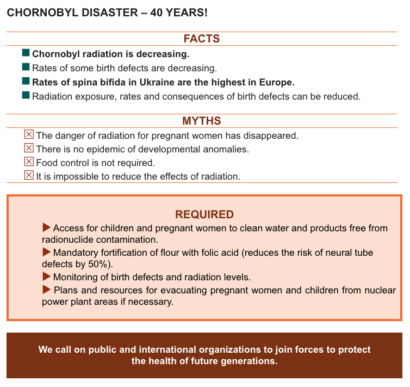
Key findings call for action:
- Access for children and pregnant women to clean water and products free from radionuclide contamination.
- Mandatory fortification of flour with folic acid (reduces the risk of neural tube defects by 50%).
- Monitoring of birth defects and radiation levels.
- Plans and resources for evacuating pregnant women and children from nuclear power plant areas if necessary.
Resources: