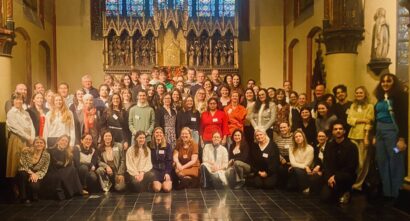
 On 27–28 February 2026, ERN eUROGEN was represented at the first ERN-wide Transition in Rare Diseases Workshop, held in Ghent, Belgium. Organised by ERN RARE-LIVER, the event brought together paediatric and adult healthcare providers and young patient representatives from 22 European Reference Networks to develop practical recommendations and minimum standards of care for young people moving from paediatric to adult services.
ERN eUROGEN was represented by three participants: Prof. Dr. Med. Raimund Stein (Universitätsklinikum Mannheim), ERN eUROGEN Expertise Area Coordinator for Adult Uro-Recto-Genital Reconstructive Surgery and Chair of the ERN eUROGEN Transition & Lifelong Care Working Group; Dr. Noemi Deanesi (Ospedale Pediatrico Bambino Gesù), who is completing her specialisation in urology with a focus on transitional care in paediatric urology and is contributing to a national Italian framework for urological transitional care in collaboration with multiple Italian professional societies; and Luc Zwiep, a young adult from the Netherlands, who lives with bladder exstrophy and is ERN eUROGEN’s representative on the cross-ERN Youth Panel.
A two-day programme built on shared experience
The two-day programme combined plenary presentations with interactive workshops supported by service design experts. Participants explored current barriers to transition care, exchanged experiences across networks and disease areas, and collaborated to shape practical recommendations and define minimum standards. A key milestone was the official launch of the cross-ERN Youth Panel, whose first in-person meeting brought essential lived experience directly into the discussions.
Across all groups, common themes emerged: the need for clearer, more timely information; stronger peer support and mental health resources for young people; and improved education for healthcare professionals in communicating with adolescents and young adults. Participants also noted persistent national system barriers and the recurring challenge of limited time to deliver structured transition care.
The patient perspective: what matters most
For ERN eUROGEN, one of the most valuable aspects of the workshop was the direct input of patient voices, including through Luc Zwiep’s participation in the Youth Panel’s first in-person meeting.
Luc reflected on what the workshop revealed about patient priorities:
“The workshop in Ghent highlighted how strongly patients with rare conditions value clarity, predictability, and trust during the transition from paediatric to adult care. I was struck by how different centres organise transition — for example, a clear ’18+ adult route’ versus maximum continuity — yet patients consistently express the same core needs across models. Across multiple sessions, having a named contact person, a clearly defined transition pathway, and patient-centred information were repeatedly identified as both feasible and high-impact. There was also a strong message that mental health, sexual health, fertility/pregnancy, and psychosocial impact should be normalised as routine parts of follow-up — not only addressed when patients explicitly raise them.”
From these discussions, several practical priorities stood out clearly:
- A named point of contact around transition and adult follow-up reduces barriers and helps patients organise their questions before specialist appointments.
- A clear pathway — covering the phases of transition, which clinicians are seen and when, standard follow-up, and what to do between routine visits — helps prevent patients from becoming lost to follow-up.
- High-quality, patient-facing information, ideally maintained as a central resource, reduces reliance on fragmented or unreliable sources. Translating strong existing resources can be more efficient than starting from scratch.
- Structured attention to sexual health, fertility and pregnancy, and psychosocial wellbeing should be embedded in routine care, with clear referral routes to real expertise — not simply noted as topics for discussion.
- A medical passport or documentation tool supports acute care and reduces patients’ burden of repeatedly explaining or proving their condition to clinicians unfamiliar with it.
As Luc put it: “During transition, patients are often looking for clarity and reassurance — simply knowing what to expect makes a huge difference. A named contact person and a clear pathway can make care feel both safer and more human.”
Looking ahead
The conclusions from the Ghent workshop will inform the ongoing work of the Cross-ERN Transition Working Group, with follow-up online meetings planned to translate the shared insights into concrete actions. For ERN eUROGEN, the workshop has provided important input for its internal Transition & Lifelong Care Working Group, which is developing a practical, implementation-focused framework for lifelong care in rare uro-recto-genital conditions.
ERN eUROGEN thanks ERN RARE-LIVER for the excellent organisation of this landmark event.