
The annual European Association of Urology (EAU) congress held this year in London from 13 to 16 March provided ERN eUROGEN with an outstanding platform to share our work, connect with the wider urology community, and demonstrate the vital role that European Reference Networks play in improving care for patients with rare and complex conditions.
Our Thematic Session
The centrepiece of the network’s presence at EAU26 was our Thematic Session, ERN eUROGEN: Update on rare & complex urology, held on Sunday 15 March. Chaired by Coordinator Peter Mulders and Programme Manager Michelle Battye, the 90-minute session brought together clinicians and patient advocates from across Europe to share the latest developments in rare uro-recto-genital diseases and complex conditions.
Prof. Mulders opened the session with an introduction and an update on ERN eUROGEN’s activities, then handed over to members of our European Patient Advocacy Group (ePAG), who gave compelling presentations illustrating the power of patient involvement in shaping rare disease care.
Patient voices at the heart of the session
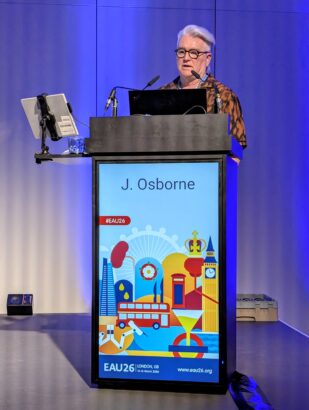
Rob Cornes (Male Cancer Information Nurse, Orchid Male Cancer) and John Osborne (penile cancer survivor and ERN eUROGEN ePAG Chair) presented findings from a penile cancer patient survey, conducted with the support of ERN eUROGEN and the EAU Patient Office.
John noted that the survey has uncovered “striking findings, which challenge accepted assumptions about the patient experience, in particular, the impact on the quality of life, and the number of men who have considered self-harm”.
A particularly urgent call to action emerged from the data: that psychological support for all patients with penile cancer should be obligatory, not optional, alongside the development of disease-specific PROMs and a dedicated primary care training programme.
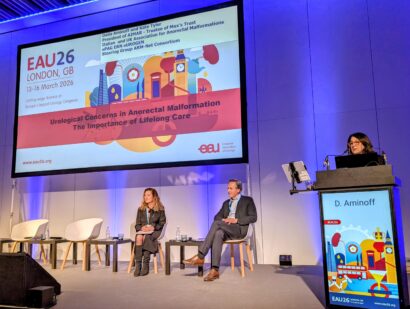
Dalia Aminoff (leader of the Italian patient organisation for anorectal malformation, AIMAR, and ERN eUROGEN ePAG member) and Kate Tyler (Trustee of Max’s Trust and ERN eUROGEN ePAG member) presented on urological concerns in anorectal malformation (ARM) and the importance of lifelong care.
Dalia is the mother of a son born with ARM, and Kate was born with ARM. Their key message was clear: “50% of patients born with anorectal anomalies have a urological problem that may continue throughout the patient’s life. It is essential to have an adult urologist taking care of these patients, particularly for those with complex malformations or prior bladder augmentation or urinary diversion“.
Clinical presentations across the three workstreams
The session then moved through ERN eUROGEN’s three clinical workstreams, showcasing the breadth of expertise within the network.
Under Workstream 1 (Rare congenital uro-recto-genital anomalies), Giovanni Mosiello (Rome) presented on mapping centres for rare and complex diseases and how this can improve the management of spina bifida and other malformations.
The other presentation in this workstream was by Alice Höller (Tübingen) on surgical and non-surgical treatment options for the creation of a neovagina in patients with XX-DSD and XY-DSD, and vaginal reconstruction options in patients with complex obstructing Müllerian duct malformations.
 Workstream 2 (Functional uro-recto-genital conditions requiring highly specialised surgery) featured a presentation by Felix Campos-Juanatey (Santander) on genital lichen sclerosis, a chronic, inflammatory condition that impairs quality of life. Surgical management and complex reconstruction beyond the urethra should be tailored to each patient’s needs, aiming to restore both function and appearance.
Emphasising the breadth and variability of presentations seen in clinical practice, he noted: “Patients with lichen sclerosis have a wide variety of severity in their presentations, and we should be able to offer solutions for all of them.”
The other presentation in this section was by Anne-Francoise Spinoit (Ghent) on phalloplasty in complex penile reconstruction cases.
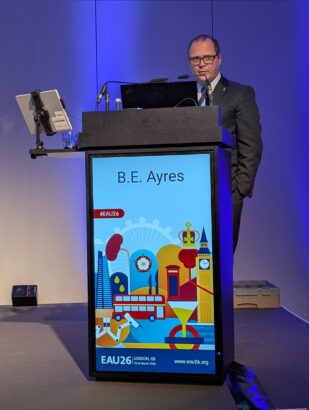 Workstream 3 (Rare urogenital tumours) featured a presentation by Ben Ayres (London) on the use of patient-reported outcome measures (PROMs) to promote holistic consultations and address unmet psychosocial needs in patients with penile cancer. Drawing on his team’s clinical experience, Ben highlighted how PROMs can break down barriers to communication, with far more patients raising concerns about intimacy, voiding changes, and quality of life through structured PROMs than through standard assessment tools alone.
His closing message: “We must continue to work hand-in-hand with our patient advocates to try to understand their experiences, and we must not be afraid to open Pandora’s box.”
The session concluded with a presentation by Jeremy Oates (Manchester) on the surgical management of retroperitoneal sarcoma.
Beyond the Thematic Session
ERN eUROGEN’s ePAG members made their mark across the wider scientific programme too. On Friday, 13 March, Anna De Santis (representative of the Italian association for interstitial cystitis, AICI, and ERN eUROGEN ePAG member) chaired the Patient Advocacy Roundtable on sleep deprivation in urology patients, and Rob Cornes chaired the Patient Advocacy Roundtable on the psychological and intimacy impact of penile cancer, where John Osborne also spoke.
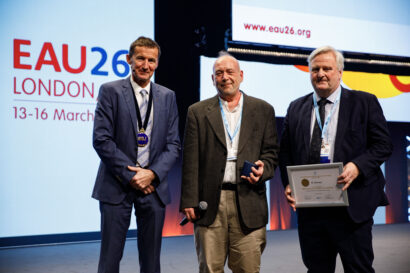 The Opening Ceremony on Friday brought a particularly proud moment for the ERN eUROGEN community: Rob Cornes was awarded the EAU Patient Advocacy Medal of Excellence, in recognition of his career-long dedication to raising awareness of male cancers through support, education, and patient information. Our congratulations go to Rob for a truly well-deserved honour.
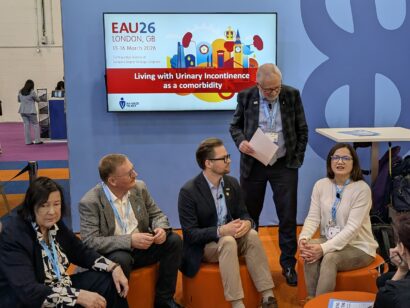
On Saturday, Rob Cornes also contributed to the EAUN Thematic Session on the testicular cancer pathway, while Anna De Santis spoke at the EAU Policy Office’s launch of their paper Coexisting Conditions: Urinary Incontinence as a Non-Communicable Disease Comorbidity, as part of the An Urge To Act campaign, sharing her experience of living with urinary incontinence and its comorbidities. On Monday, John Osborne also spoke in the Plenary Session on penile cancer and quality of life.
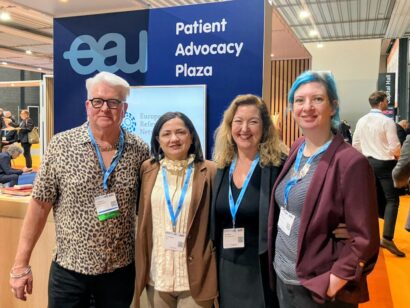
Throughout the congress, ERN eUROGEN hosted an Information Desk in the EAU Patient Advocacy Plaza, where delegates could drop in to learn about our work, ask questions, and find out how we support patients across Europe.
A congress to remember
EAU26 was a powerful reminder of how bringing together patient advocates and clinicians can advance care for people living with rare uro-recto-genital diseases and complex conditions.
We are deeply grateful to the EAU, our Supporting Partner, for the opportunity to participate in their congress, and to the EAU Patient Office and EAU Policy Office for their collaboration and support in championing patients’ voices across the wider scientific programme. Our thanks also go to all the presenters and ePAG members who represented ERN eUROGEN so capably in London.
The partnership between ERN eUROGEN and the EAU continues to be valuable, and we look forward to building on it in the year ahead.